

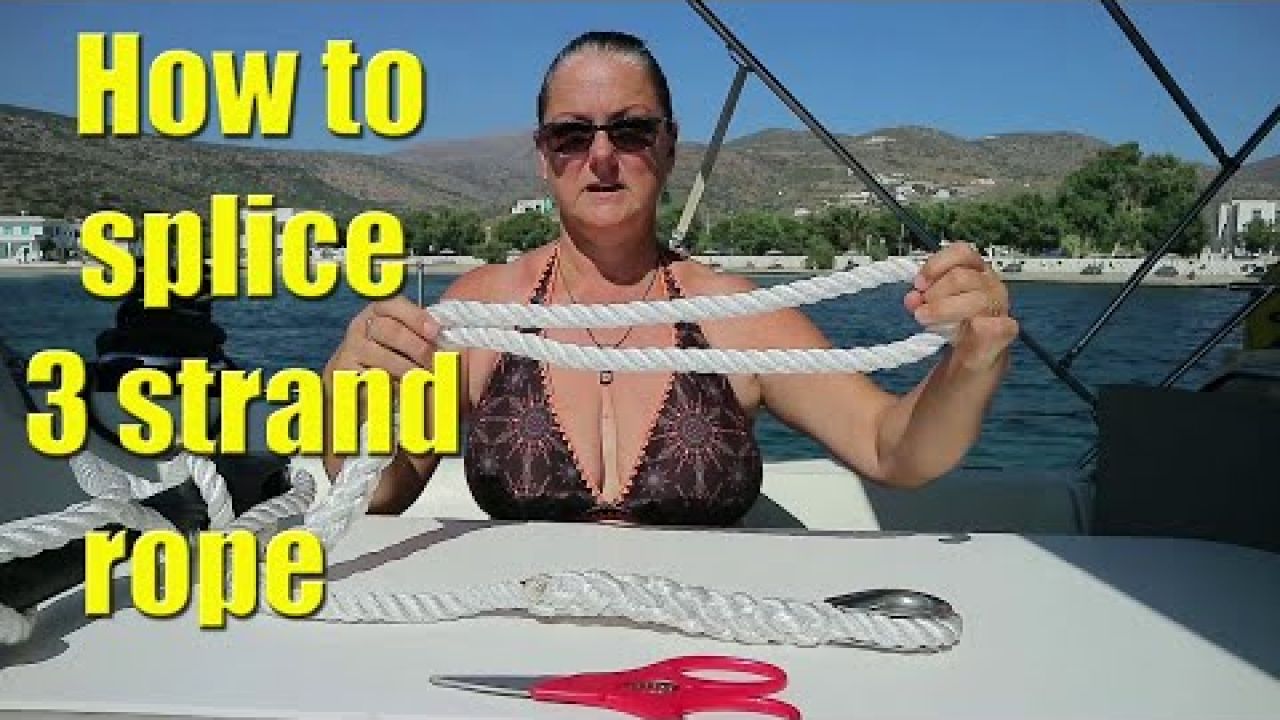
In this bonus episode of Sailing A B Sea Aannsha walks you through the whole process of how to splice rope to make a snubber. We like redundancy with most th...
Closed Captions (CC):
Today I'm going to make a snubber. We've
already got one but we like to have
redundancy so I'm going to make a second
one today and I'm recording it because a
couple of subscribers have asked to see
how I actually do splicing.
This end goes
through and around the cleat. This end
gets attached to the anchor chain and
we let out enough anchor chain so that
this whole rope becomes tight but it's
got flexibility and that takes the
weight and the strain of the windlass.
So what I'll be using today are obviously
the rope, a rubber stretchy thing that
feeds through and around the rope to
give it a bit of give. I'm going to be
using on one end a metal thimble, some
different coloured electrical tape, two
different colors of waxed whipping, a
tool to help actually push the line
through itself and some scissors.
And the final bit we'll use these two pieces which
I'll show when I've finished actually making the snubber.
Two ends! So on
one end I'm going to make a loop that is
big enough to go over the cleat and the
other end is where I'm going to attach
the thimble.
So I'll start with the cleat end first
That's going to be the loop for the
cleat and that is going to be what I'm
going to feed through here.
Okay so I've done quite a few, you only
have to do one two three four five
lots of threading but I had extra and
because it's actually holding the boat
the whole boat's weight I thought because
I've got the extra I will I'd just a few
extra. The important thing is to keep to
really tighten it as you go
So that's what neat
So I'm going to cut these quite short
and then I'll just burn the ends so that
they will fuse together. Some people just
cut them and leave them but I'd rather
see the end fused. And then I'm
going to use some whipping and I'm just
going to whip around this part here
which is the front of the loop
Wow, great job Baz.
This end is going to have a metal thimble and that
eventually be attached like this ... put
that onto the anchor chain. So I've
learned to give myself five lengths of this
1, 2, 3, 4, 5
Tie this tight.
Eventually that is going to go like this.
Feed this into here
Take this top one
put it into the top line ... here
And make it really tight
Then take the second one
And put it under the next one
Then this third one goes under this...
- goes over that - and under that
And then it's just over and under
over under
You want to keep the integrity of the rope
And this one is over and under
Just get it really tight
one two three four five
so I'll keep going because I've got
plenty more
So that's really firmly in
Fabulous! Look at that
So all I need to do now is cut the ends
and burn them like I did with this one
And then all
I've got to do is whipping just to just
to be sure to be sure.
So we have got our
end that goes around cleat and we have
got the thimble that is going to be attached to this and that will hook onto the
anchor chain and now all I'm going to do
is I'm going to take some whipping - this
is blue waxed whipping it's one
millimetre, you can get different thicknesses
and stuff and I'm just going to bind the
two ends with the whipping just to make
it more secure
So make a little loop
I'm gonna bind it just about here where
the the other whipping is, where the join
is so I'm gonna start here
I think the important thing with whipping
is that it's tight
All right
I'm happy with that
So I'm gonna cut end and feed it through the loop
I'm gonna pull this
so I've fed it through the loop and I'm
pulling this end and this end is pulling
this end through.
So there's that one whipped
And there's that one. Not bad for an amateur!
I'm happy with it.
And so this now, Barry will attach this with
seizing wire and probably some Loctite
but this will go around here
Like this. So this end goes through
and around the cleat
this end gets attached to the anchor chain
and we let out enough anchor chain so
that this whole rope becomes tight but
it's got flexibility and that takes the
weight and the strain of the windlass
There you have it, a snubber
How to splice rope to make a snubber - Sailing A B Sea bonus video
Uploaded by:
Sailing A B Sea
•
Category:
Boat Building/Maintenance/Repair, Instructional
•
Added on
07 August 2019
Description
In this bonus episode of Sailing A B Sea Aannsha walks you through the whole process of how to splice rope to make a snubber. We like redundancy with most th...
Closed Captions (CC):
Today I'm going to make a snubber. We've
already got one but we like to have
redundancy so I'm going to...
Closed Captions (CC):
Today I'm going to make a snubber. We've
already got one but we like to have
redundancy so I'm going to...