

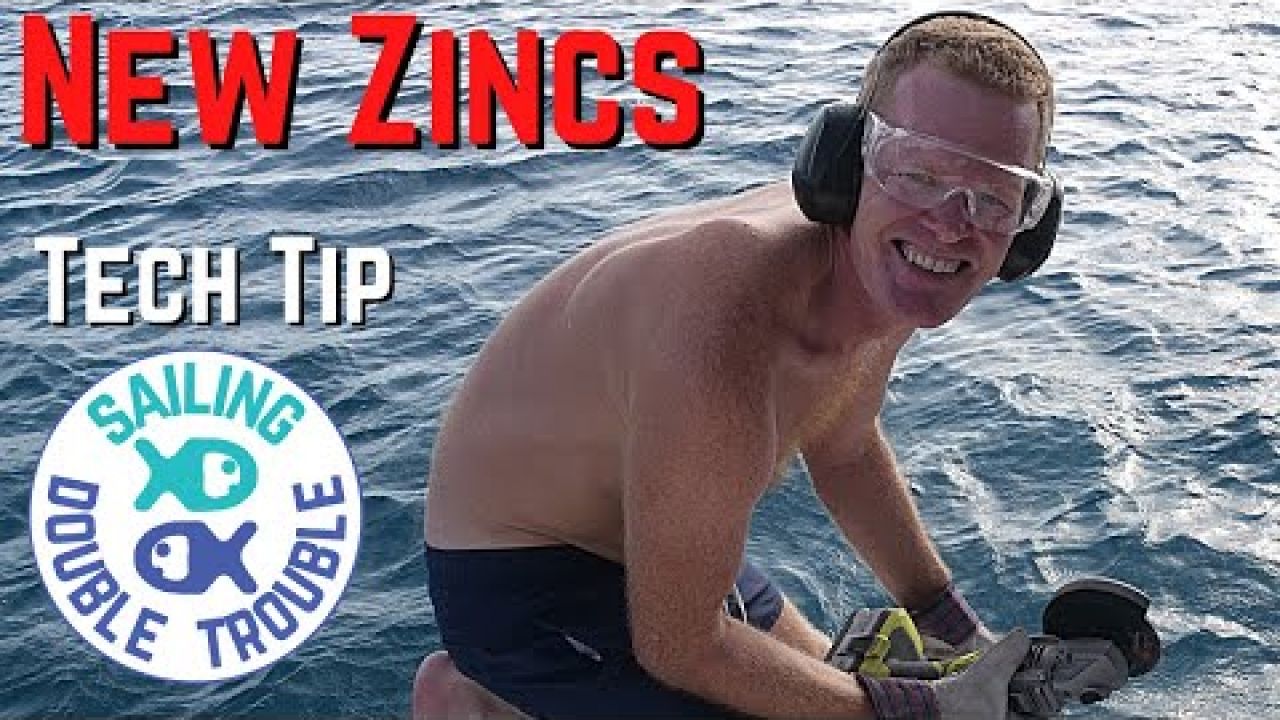
Sailboat, sailing and replacing zincs Replacing the Zincs on our Volvo folding Propellers - in the water. TECH Tip In this video we focus on some of the technical and maintenance jobs we get up to on Double Trouble. If you like the video let us know with a thumbs up! Sacrificial zincs are attached to our sail drive legs and propellers and are used to protect metal structures from corroding. They work by oxidizing more quickly than the metal they are protecting, and are consumed before the other metal reacts with the electrolytes. This means our expensive aluminium sail drives and and brass propellers will be less susceptible to galvanic corrosion. We normally do this on the hardstand, but with no option for hauling DT out of the water, we put on a snorkel and jump in to replace the anodes. ------------------------------------------------------------------------------------------------------ ☕️ Want to Buy us a Coffee? Support our videos: https://ko-fi.com/sailingdoubletrouble 🌎 Blogs and updates on the website: http://sailingdoubletrouble.com/ 💁🏼♀️ Photos and real time stuff here: https://www.facebook.com/sailingdoubletrouble/ 📷 Random Travel Pics and updates: https://www.instagram.com/sailingdoubletrouble/ 👉Subscribe to our channel: https://www.youtube.com/c/SailingDoubleTrouble?sub_confirmation=1 -------------------------------------------------------------------------------------------------------- 👩❤️👨About us : Hello and welcome to our channel! We are Jo and Rob and we are here to share our sailing adventures with you. In 2016, inspired by the likes of ‘Delos’, ‘Sailing La Vagabonde’ and ‘Gone with The Wynns’, we sold up everything we owned and bought our 40ft, Fountaine Pajot ‘Lipari 41 Evo’ sailing catamaran ‘Double Trouble’. We had no sailing experience whatsoever, so the past few years have been a huge learning curve. We thought it might be fun to document our travels for anyone thinking of following a similar lifestyle. So far we have visited 7 different countries and sailed over 13,000 nautical miles. We have had many unique experiences that would not have been possible in our prior life and we don’t regret a second. We're both super keen on protecting our precious environment, so amongst other things, we both follow a plant based diet. You wont find any fishing footage on this channel! Subscribe now and join us as we continue our salty travels around the world. https://www.youtube.com/c/SailingDoubleTrouble?sub_confirmation=1 👏Credits: Thanks to 'Shure ' microphones for voiceover sound. 🎼Music: DT Theme tune - 'Happy' by MBB https://soundcloud.com/mbbofficial Creative Commons — Attribution-ShareAlike 3.0 Unported — CC BY-SA 3.0 http://creativecommons.org/licenses/b... Music promoted by Audio Library https://youtu.be/g6swHZbWtRc 🎧Other Music: Epidemic Sound Library #sailingdoubletrouble
Closed Captions (CC):
today we are changing the zinc's on our
sail dried legs
hi there we've decided to put together
some short technical videos documenting
some of the repairs and maintenance that
we get up to on double trouble this
won't be a regular thing we'll just
publish them when we think there is
something relevant to show so if there's
any particular topics that you would
like to see please let us know in the
comments below
[Music]
we have Volvo three-bladed folding props
and we have two sets of zinc's first are
on the actual sale drive leg
I've just had a quick look at them
they're fine they seem to last probably
a couple of years for some reason we do
have some more saints that are on our
props themselves and they go around in a
collar so I've got some here and these
haven't lasted as long they're not quite
as big so we're going to be looking at
changing them out today these go around
the prop shaft we're going to change
them in the water so we haven't done
this before on our boat we normally do
it when we call out and we aren't
planning on getting the boat out of the
water in the short term one thing that
we use is locked tight so we typically
use this on dry land the nice thing
about that is you're not in the water
and the Loctite has a chance to stick to
the screw and then when you screw it in
acts like a glue so the screw doesn't
fall out and then you don't lose any you
think anodes we've only got the two four
three block tight which is not
technically waterproof but apparently
there is a little bit of a trick you can
put this on the screw thread leave it to
dry for an hour it'll go stachy and
stick and then you can use it in the
water alternatively you could use two
four eight Loctite which we haven't got
access to and there's a few other
products as well if you check the
comments and the link below is some of
the things that we're going to be using
to do an in water zinc change we
obviously need the zinc's we're using
Volvo sinks which are quite pricey there
are a number of other aftermarket parts
you can get MARTA are a good option they
have sink starting at around fifteen
dollars and the smaller ones they're
probably in the region of about thirty
so some savings there again the links
are below if you want to check those out
we're gonna remove the existing zinc's
and then we just need to clean up the
area that they're going to be installed
in so to do that we have some green
scrubby stuff that will allow us to just
get rid of any growth and make sure that
these sakes have a nice clean contact
onto the brass of the
some wet and dry sandpaper just some
fine grade stuff and I can I can use
that to make sure everything is super
clean I've also got a waterproof
screwdriver that I can use if I've got
any tough bits that I need to chip out
then I can use that in conjunction with
this that'll get it all nice and clean
there are some metric allen keys see
what size you need and then take that
down into the water with you and and
screw it in because we're going to be in
the water you obviously need some seeing
goggles so we've got a nice underwater
mask here in my case I'm going to be
using a snorkel but if if we need to
then we would also use our dive gear and
just roll in with those I'm going to get
one of our buckets with a bit of string
over the top and put it underneath the
drive and then if we do knock anything
or anything falls then it will fall into
the bucket and it won't fall to the
bottom of the sea with the lock tight
give it a good mix and then just apply
it gently to the thread and then you
just leave it for an hour to soak in and
dry
so shock horror I've just read the
manual and on the zinc's they also
recommend you get some oxidization on
this as it's in the air and they
recommend that you give it a good clean
either with a very rough Buffett or I'm
actually just going to use some
sandpaper and and just clean all this up
so that it's it's fresh the surprising
thing for me I tried it with the snorkel
it's it's fine but there's a surprising
amount of current that you're always
cooking against so just gonna be easy
just throw this on
[Music]
[Applause]
[Music]
here's the old zinc's and as you can see
they look a little bit different to the
new ones so after a year definitely time
to change them out and yeah the new ones
will continue to do their job thank you
so much for watching if you enjoyed this
video please subscribe and leave us a
comment below if you'd like to support
our journey please head over to our Kofi
page and buy us a coffee for real-time
updates please check our Facebook and
Instagram pages
[Music]
Uploaded by:
Jo Birch
•
Category:
Boat Building/Maintenance/Repair, Instructional
•
Added on
13 March 2021
•
Location:
Marshall Islands
Description
Sailboat, sailing and replacing zincs Replacing the Zincs on our Volvo folding Propellers - in the water. TECH Tip In this video we focus on some of the technical and maintenance jobs we get up to on Double Trouble. If you like the video let us know with a thumbs up! Sacrificial zincs are...